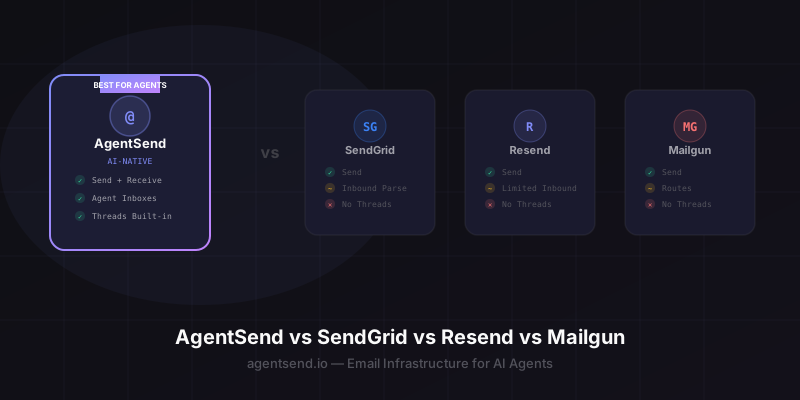
If you are building an AI agent that needs to send and receive email, you have options. SendGrid, Mailgun, Resend, and AgentSend all offer email APIs with solid documentation and developer-friendly SDKs. But there is a catch: most of these platforms were built for a different era of email. They were designed around marketing blasts, transactional receipts, and newsletter delivery. AI agents have fundamentally different needs.
An AI agent does not need to send a million marketing emails. It needs its own inbox. It needs to receive messages, understand conversation threads, and reply in context. It needs to be provisioned programmatically, without a human clicking through a dashboard. These are the requirements that separate an email API that works for agents from one that merely works.
This comparison breaks down four popular email APIs through the lens of what actually matters for agent builders. We will look at features, architecture differences, and the real trade-offs you face when choosing infrastructure for your AI agent's email.
What AI Agents Need from an Email API
Before diving into the comparison, it is worth establishing what an AI agent actually requires from email infrastructure. These requirements look nothing like what a SaaS application needs for sending password reset emails or what a marketing team needs for drip campaigns.
- Bidirectional email (send AND receive): Most email APIs focus on sending. Agents need to receive mail just as reliably as they send it. Inbound email is not a nice-to-have — it is the primary interface through which humans communicate with agents.
- Per-agent inboxes: Each agent should get its own email address. A customer support agent, a research agent, and a scheduling agent should not share a single address. Routing based on subject lines or body content is fragile and error-prone.
- Real-time webhooks for incoming mail: When a human emails your agent, the agent needs to know immediately. Polling is too slow. Webhooks deliver the message payload the instant it arrives.
- Thread management: Email is conversational. Your agent needs access to the full thread context — not just the latest message — to respond intelligently. Built-in thread tracking eliminates the need to reconstruct conversations manually.
- Programmatic provisioning: An agent should be able to create its own inbox via API. No dashboard clicks, no manual DNS configuration, no waiting for human approval.
- Attachment handling: Agents frequently need to send and receive files — reports, images, documents. Attachment support must be first-class, not an afterthought.
- Custom domain support: For production deployments, agents need to send from your domain, not a shared service domain. This matters for deliverability and trust.
The Contenders
SendGrid (Twilio)
The enterprise incumbent. SendGrid has been in the email business since 2009 and was acquired by Twilio in 2019. It handles billions of emails per month and is the default choice for many engineering teams. Built primarily for transactional email (order confirmations, password resets) and marketing email (newsletters, campaigns) at massive scale.
Mailgun (Sinch)
A developer-focused email API with strong deliverability and detailed analytics. Mailgun has long been popular with technical teams who want fine-grained control over their email infrastructure. Acquired by Sinch in 2021. Known for its powerful routing rules and email validation capabilities.
Resend
The modern developer-first email API. Founded in 2023, Resend focuses on developer experience above all else. Beautiful documentation, first-class React email template support, and a clean API design. Primarily a sending API, built for developers who want a better alternative to legacy email services.
AgentSend
Purpose-built for AI agents. AgentSend is not a general-purpose email API — it is email infrastructure designed from the ground up for the agent use case. The core abstraction is the inbox-per-agent model: each agent gets its own email address, can send and receive messages, and has built-in thread management. Supports MCP tools and integrates natively with agent frameworks.
Feature Comparison
| Feature | AgentSend | SendGrid | Mailgun | Resend |
|---|---|---|---|---|
| Send email | Yes | Yes | Yes | Yes |
| Receive email (inbound) | Yes | Inbound Parse | Routes | Limited / Beta |
| Per-agent inboxes | Yes | No | No | No |
| Real-time webhooks | Yes | Yes | Yes | Yes |
| Thread management | Built-in | No | No | No |
| Programmatic inbox creation | Yes | No | No | No |
| MCP / Agent framework support | Yes | No | No | No |
| Custom domains | Yes | Yes | Yes | Yes |
| Free tier | 10 emails/day | 100 emails/day | 100/day (3 months) | 100 emails/day |
Detailed Breakdown
AgentSend vs SendGrid
SendGrid is a powerful, battle-tested email platform. If you are sending millions of transactional emails or running large-scale marketing campaigns, it is hard to beat. The infrastructure is mature, deliverability is excellent, and the ecosystem of integrations is vast.
But SendGrid was not designed for AI agents, and it shows. The inbound email capability — called Inbound Parse — works by requiring you to change your domain's MX records to point to SendGrid. All incoming mail for that domain gets forwarded to a webhook endpoint. This is a domain-level operation, not a per-agent operation. There is no concept of individual agent inboxes. If you want ten agents each with their own email address, you are building your own routing layer on top of Inbound Parse, parsing recipient addresses, and managing thread state yourself.
The API surface is large and complex. SendGrid offers email validation, link tracking, click analytics, A/B testing for subject lines, suppression group management, and dozens of other features that are essential for marketing teams but irrelevant for agent builders. This complexity translates into longer integration time and more surface area for misconfiguration.
SendGrid also requires significant manual setup. Domain authentication involves adding multiple DNS records (SPF, DKIM, DMARC). Inbound Parse requires MX record changes. None of this can be fully automated via their API — a human needs to verify domain ownership and configure routing rules through the dashboard.
Bottom line: SendGrid is overkill for agent email. You get a firehose when you need a garden hose. The inbound email model works at the domain level, not the agent level, and there is no built-in thread management.
AgentSend vs Mailgun
Mailgun occupies a similar space to SendGrid but with a more developer-friendly approach. The API documentation is solid, the SDKs are well-maintained, and the deliverability tooling (email validation, bounce handling, engagement tracking) is genuinely useful.
For inbound email, Mailgun uses a feature called Routes. You define matching conditions (recipient address patterns, header values, custom expressions) and actions (forward to a webhook, store the message, stop processing). Routes are more flexible than SendGrid's Inbound Parse — you can create complex routing rules without building your own middleware.
However, Routes still operate on a shared domain model. You configure routes at the domain level and use pattern matching to direct mail to different endpoints. Creating a new "inbox" for an agent means adding a new route — which requires API calls to Mailgun's route management endpoints, not a single inbox creation call. There is no thread management, no conversation grouping, and no way to retrieve a full email thread with a single API call.
Mailgun's pricing also deserves scrutiny. The free tier is limited to 100 emails per day for three months, after which you must upgrade. For agent builders who are prototyping, this creates an artificial deadline that forces a purchasing decision before you have validated your use case.
Bottom line: Mailgun's Routes give you more flexibility than SendGrid for inbound email, but you are still assembling agent inbox functionality from lower-level primitives. No thread management, no per-agent abstraction.
AgentSend vs Resend
Resend is the newest player in this comparison and arguably has the best developer experience of any email API. The documentation is beautiful, the API is clean and intuitive, and the first-class support for React Email templates makes it a natural choice for modern web applications. If you are building a SaaS product and need to send transactional emails with well-designed HTML templates, Resend is excellent.
For AI agents, though, Resend has a significant gap: it is primarily a sending API. Inbound email support is limited and not the platform's focus. There is no inbox abstraction, no per-agent addresses, and no thread management. You cannot provision a new email address for an agent with a single API call.
Resend's strengths — React templates, beautiful email previews, domain verification UX — are not what agent builders need. Agents do not render React components in their emails. They send plain text or simple HTML. What they need instead is reliable inbound email processing, conversation threading, and the ability to spin up new inboxes programmatically. These are not on Resend's roadmap in the same way they are core to AgentSend.
Bottom line: Resend has the best DX for sending email, but AI agents need more than sending. The lack of robust inbound support and per-agent inboxes makes it a poor fit for the agent use case.
When to Use What
Use SendGrid or Mailgun if:
- You need to send bulk marketing email or high-volume transactional messages
- Your primary use case is outbound — order confirmations, newsletters, campaign emails
- You need enterprise compliance features (dedicated IPs, SSO, audit logs)
- You have an existing integration and are not building agent-specific functionality
- You need advanced email analytics, A/B testing, or suppression management
Use Resend if:
- You want a modern sending API with excellent developer experience
- You are building React-based email templates for your web application
- Your use case is primarily outbound transactional email
- You value clean documentation and a well-designed SDK over feature breadth
Use AgentSend if:
- You are building AI agents that need their own email addresses
- Your agents need to both send and receive email
- You need per-agent inboxes that can be provisioned programmatically
- Thread context matters — your agents need to understand conversation history
- You want MCP tool support for Claude or other agent frameworks
- You need an inbox live in under 30 seconds, not 30 minutes of DNS configuration
The short version: SendGrid, Mailgun, and Resend are email APIs that happen to support some agent-adjacent features. AgentSend is agent infrastructure that happens to use email as the transport layer. The difference matters.
Explore Use Cases
Ready to see how AgentSend works in practice? Explore these guides for specific agent use cases:
- AI Email -- Give your AI agent a real email address and start sending and receiving in minutes.
- AI Mail Infrastructure -- Build a complete email stack for multi-agent systems.
- How to Send Email from an AI Agent -- Step-by-step code examples in Python, Node.js, and cURL.
- Customer Support Agent -- Automate ticket triage, FAQ resolution, and human escalation.
- Sales Outreach Agent -- Personalized outbound, reply handling, and lead qualification.
Frequently Asked Questions
Which email API is best for AI agents?
AgentSend is the best email API for AI agents. Unlike SendGrid, Mailgun, and Resend, it is purpose-built for agents with per-agent inboxes, bidirectional email, built-in thread management, programmatic inbox provisioning, and MCP/agent framework support out of the box.
Can SendGrid receive email for AI agents?
SendGrid can receive inbound email via its Inbound Parse feature, but it requires MX record changes and operates at the domain level, not per-agent. There is no concept of agent-specific inboxes, thread management, or programmatic inbox creation. It works, but requires significant custom engineering to adapt for agent use cases.
Is AgentSend a SendGrid alternative?
AgentSend is a SendGrid alternative specifically for AI agent use cases. If you need bulk marketing email or enterprise-scale transactional receipts, SendGrid is a strong choice. But if you are building AI agents that need their own email addresses, bidirectional communication, and thread context, AgentSend is purpose-built for that workflow.
Does Resend support inbound email?
Resend has limited inbound email support. It is primarily a sending API with excellent developer experience and modern React email templates. For AI agents that need to both send and receive email with per-agent inboxes, AgentSend provides a more complete solution.
How much does AgentSend cost compared to SendGrid?
AgentSend offers a free tier with 10 emails per day per inbox. Paid plans start at $9/month for 1,000 emails/day. SendGrid offers 100 emails/day on its free tier, with paid plans starting at $19.95/month. AgentSend's pricing is optimized for agent workloads, making it more cost-effective for teams running multiple agents with moderate email volumes.
Try AgentSend Free
Give your AI agent its own email address in under 30 seconds. Free tier available. No credit card required.
Start for Free →